

When I See Cotton I See Red: A Discussion Program at the Muzeum Sztuki in Łódź
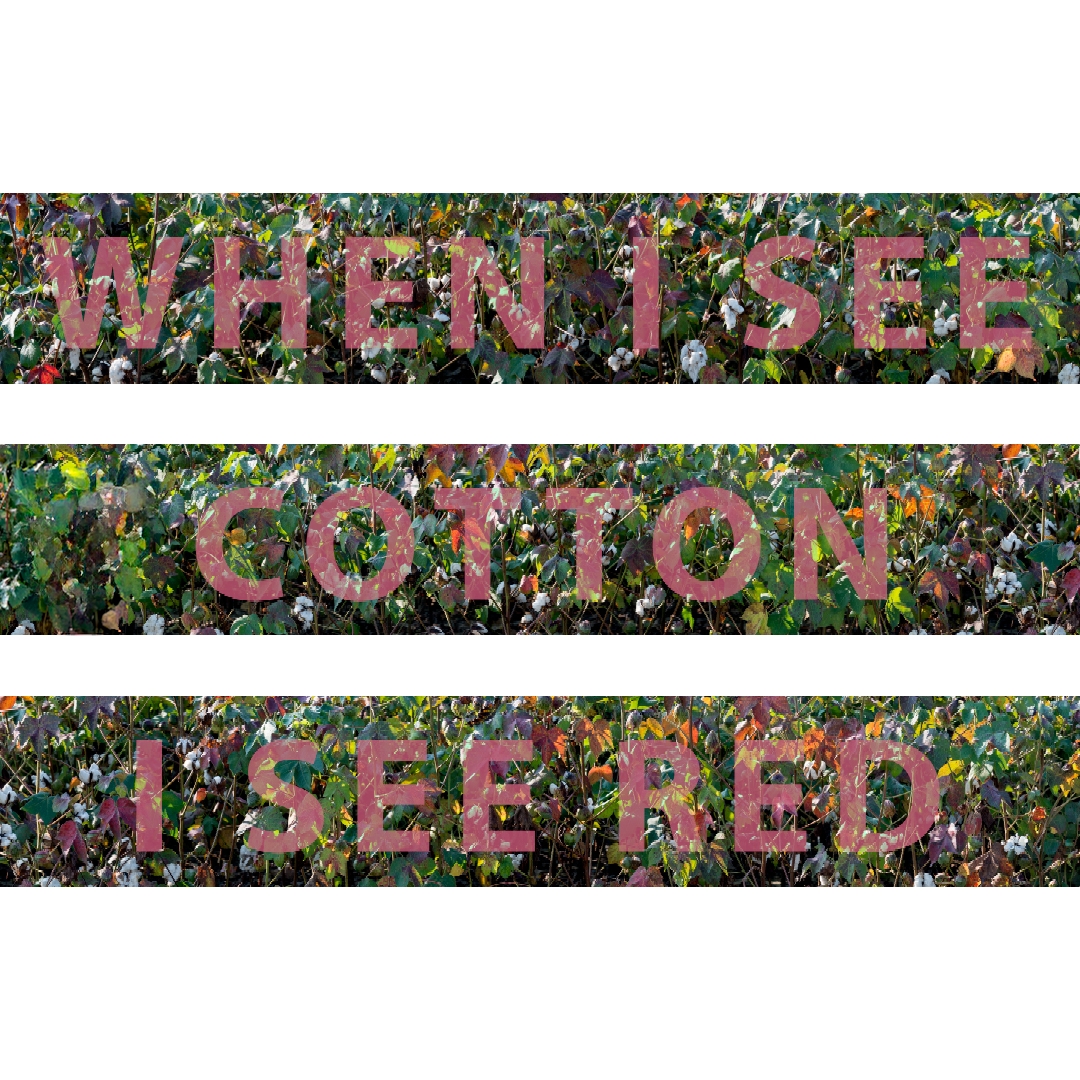
John E. Dowell: When I See Cotton I See Red (2017)
Can the old links of violence binding us to the Black populace of America become bonds of memory and solidarity?
Łódź, the first industrial metropolis in Polish lands, owes its rapid development to cotton—a plant that does not grow in Poland.
From the dawn of the nineteenth century, the prosperity of the textile industry born in England was based on extremely cheap cotton from the USA. In the fields of the American South, it was harvested by slaves.
INFO
Place
Project initiator and curator
Title work
Research
Graphic design
Project coordination
Collaboration
In Łódź, too, the fortunes of the first factory owners were made not only off the local weavers’ and spinners’ backs, but also the grinding work of women, men, and children in Alabama and Georgia. The abolition of slavery in 1865 formally meant freedom for these people, but did not end their extreme exploitation, supported by lynchings and mob violence.
Although by the start of the twentieth century Łódź’s spinning mills began receiving mainly shipments from territories conquered by Russia, such as the Caucasus and Central Asia, in the interwar era the majority of cotton came from the USA. In 1945, the Iron Curtain made Łódź dependent on plantations in today’s Uzbekistan and Turkmenistan once and for all, and these are the sources most often associated with Łódź’s textile industry.
Is it possible today to restore the lost memory of transatlantic connections that held sway throughout the nineteenth century? How to portray the ties between Łódź and the history of the Black peoples of America, their work and their resistance?
Muzeum Sztuki in Łódź, like many of the city’s cultural institutions, is housed in the former palaces and factories that grew out of those dependencies. Does this history place any responsibility on us, looking at past and future generations?
The initiator and curator program is Olga Stanisławska, an essayist and reporter who explores colonial and multicultural themes. The museum building was, for many years, partly her family home—with her parents, who were art historians, she lived in the side wing of Maurycy Poznański’s old palace. Since 2024, she has been working on the American roots of her hometown’s development. In February 2026, Dwutygodnik published her article called “Łódź: A Transatlantic Story.”
- When I See Cotton I See Red (2017)—a work by John E. Dowell on the MS1 façade in the old Maurycy Poznański Palace on Więckowskiego Street 36.
- “Transatlantic Łódź: Bonds of Memory, Bonds of Solidarity?”—an open conversation with guests Dr. Katarzyna Bojarska, Oliwia Bosomtwe, Dr. Wiktor Marzec and all those present. The meeting will be held by Olga Stanisławska at MS1 on Friday, October 23, 6:00 pm.
- “Visible/Invisible: A Walk in the Footsteps of Transatlantic Connections”—guides Justyna Tomaszewska and Olga Stanisławska. The route runs from the Market Square of the Old Town to MS1. Saturday, October 24, 12:00 noon.
- Black America Library—a selection of books and documents freely available at Fave Cafe, MS1.
- “Plot of Resistance”—a botanical installation in the Herbst Palace Museum, commemorating garden patches cultivated by slaves for their own use. Cotton, okra, salvia—these are only some of the plants that helped them survive, regain agency, nurture culture, and build a community.
