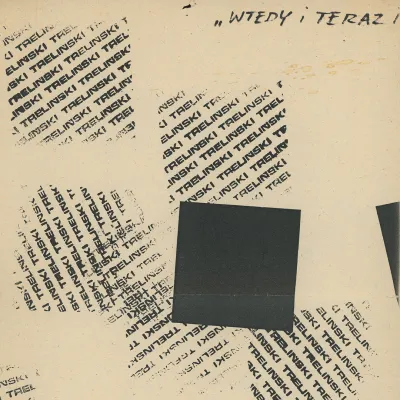
Treliński

The exhibition "Treliński" is a retrospective presentation of the work of Jerzy Treliński, an artist who—for nearly six decades—has consistently explored the boundaries between art and reality, the private and the public, and the individual gesture and the structures of social perception. His practice, situated between the post-constructivist legacy of the Łódź avant-garde and the conceptual turn of the 1970s, constitutes a unique example of artistic self-reflection and the courage to redefine the role of the artist in the contemporary world.
INFO
Place
Time
Opening
curator
graphic design
education
communication
conservation
exhibition coordination
editorial coordination
marketing
installation
public program
mirror hall design
production
The exhibition guides the viewer through three fundamental stages of this journey: from the early drawings and prints from the late 1960s, through radical conceptual and performative activities of the 1970s, to the artist’s return to traditional media—painting and printmaking—in the 1980s and beyond. The exhibition’s meandering narrative reveals the constant tension between spontaneity and intellectual rigor, between the desire for expression and the gesture of critical self-reduction.
The exhibition finds its focal point in the project Autotautology—a series of interventions, happenings, and objects in which the artist uses his own name as a symbol, a tool of analysis, and a vehicle of presence. The word TRELIŃSKI, written in block letters, becomes both a signature and a sign, a gesture of affirmation and self-irony. The multiplied inscription appears on flags, fabrics, banners, in the cityscape and landscape. In the happening Parade (Łódź, 1974), the artist holds a banner with his own name amidst a crowd of others bearing the names of their workplaces and ideological slogans; this gesture, half absurd, half heroic, questions the meaning of collective rituals and questions the limits of individual agency.
These self-tautological activities are an extension of the experiences of the 80×140 Gallery, one of the seminal conceptual-art spaces in Poland, co-created by Treliński with Andrzej Pierzgalski at the Artists’ Club in Łódź. There, the idea of a “space of presence” and tautological thinking about art was born, in which the creative act becomes its own justification. Treliński moved these experiences beyond the gallery walls: into the open air, into institutional spaces, into the cityscape. In his Interventions, the landscape becomes a field of sign activity, with geometrical traces in sand or water recording a momentary presence, only to disappear shortly thereafter.
One of the exhibition’s highlights is a reconstruction of the installation Museum—Artists (1972), originally created by Treliński for the ICOM meeting at the Muzeum Sztuki. By pasting black triangles on the corners of the walls and windows then, the artist symbolically “exploded” the geometric order of the museum interior. The current exhibition evokes this gesture as a testament to Treliński’s long-standing dialogue with the institution, which—like his work—remains a movement between affirmation and critical distance.
The final modules of the exhibition reveal the artist’s transformation into a researcher of vision and the relationships between color, form, and space. Since the 1980s, Treliński has been creating geometric compositions, serigraphs, and digital prints, in which purity of form is combined with reflection on illusion and perception. These works are accompanied by notes of thought, aphorisms, and poems revealing the spiritual, introspective dimension of his practice. In them, art becomes not so much a language for describing the world as a way of existing in it—conscious, ironically detached, yet deeply existential.
Treliński does not propose a linear biography of the artist. Instead, the exhibition creates a space for experiencing the tensions, returns, and paradoxes that constitute his art—where reflection on vision, identity, and presence intertwine with the history of the avant-garde, but also with personal history: an individual trying to see himself in the world and the world in himself.
Partner

Media patronage