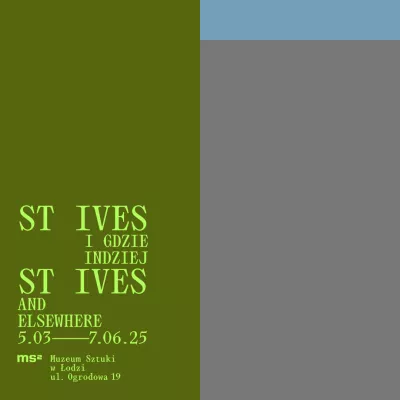
St Ives and Elsewhere

This catalog presents primarily works from the 1930s and 1960s by British artists associated with the artistic community of St Ives. Their abstract paintings and sculptures strongly correlated with the landscape and expressed the experience of being there. The album also includes paintings by Polish artists that resonate in dialogue with British works.
INFO
Place
Publisher
editing
translation
Publishing coordination
Graphic design
This exhibition emphasizes the performative dimension of a modern artwork, as being complementary to the formal one. The works gathered in the exhibition manifest a sharpened awareness of being in specific places. This determines the selection of artistic means, which, derived from proven modern art formulas, relate at the same time to the unique qualities of the landscape, and – most importantly – communicate the experience of being in it.
Modern art turned towards the landscape at moments of historical crises. In Polish art of the 1930s, landscape references can be seen as a kind of reaction to the economic turbulence of the period; because they triggered a model of perception that engaged in the processes of the environment, works from this period can be seen as an expression of the search for equilibrium, in both a physiological and social sense, in the uncertain conditions of the world at that time. In British art, landscape references intensified with the outbreak of the Second World War, reaching a culmination in the two decades that followed. There, the structures of the landscape provoked artists to redefine the tenets of abstract art, the principles of composition, and the nature of the artistic medium.
Artists associated with St Ives share a sensitivity to the unique qualities of the places in which they worked; the synthetic and processual aspects of painting and sculpture resulting from this attitude distinguish British art from the 1930s through the 1960s. These enter into an interesting resonance with the achievements of Polish artists of that period, in particular, the works of Sasza Blonder, Katarzyna Kobro, Leopold Lewicki, Władysław Strzemiński, and Adam Marczyński. The two milieus are linked by the work of Piotr Potworowski, whose sojourn in Poland in the years 1958–1962 was an opportunity to apply in the Polish context the ideas he developed in Great Britain, in an artistic dialogue with the British context. In the post-war period, the experience of landscape was considered by British artists as a catalyst for moral and social regeneration; it seems that the ecological dimension of the works showcased in this exhibition could play a similar role in the world today.