Mezzanine exhibition: Archive of Aleksander Krzywobłocki and the “artes” Group
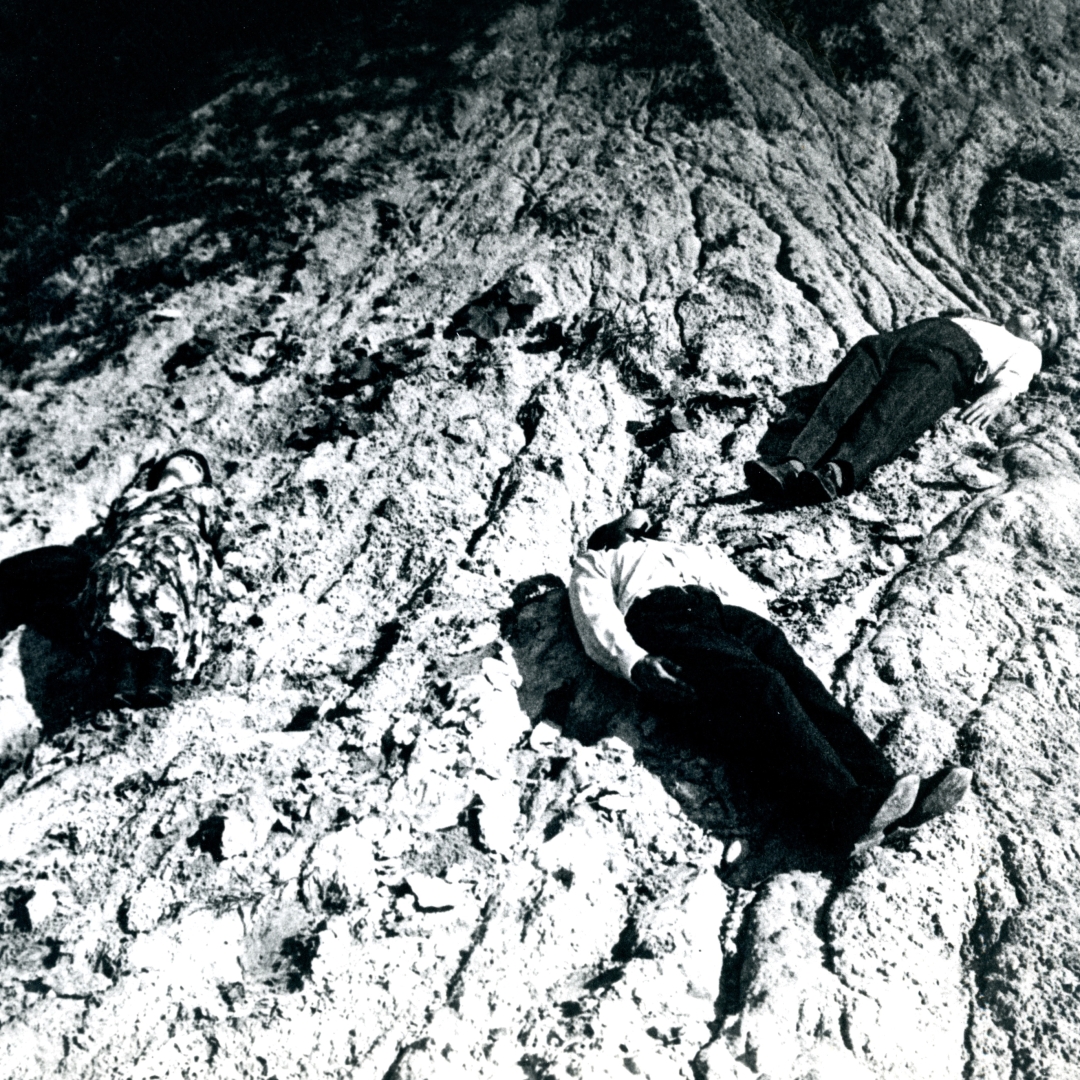
fragment of the art work: Aleksander Krzywobłocki, Assembly from nature", ok. 1930
Accepting the archive is an intimate experience — it is not a finished work, but a record of the creative process. Instead of a polished final form, we are presented with handwritten notes, unfinished texts, and working materials. Alongside sketches, reprints and original works (often previously unpublished), traces of the artist’s life appear: official documents, letters, and medical records.
INFO
Place
Time
Text and research
Editing
translation
entry
The presentation of archival materials
Thursday: 9:00 am – 6:00 pm
Earlier this year, thanks to the efforts of curator Paweł Polit, Wojciech Krzywobłocki’s donation – the personal archive of his father, Aleksander Krzywobłocki — was formally included in the collection: a unique collection of individual architectural designs, photomontages, and the artist’s written memoirs, as well as materials concerning the Lviv-based artists’ group “artes,” which he co-founded. The donation complements the archive transferred to the Muzeum Sztuki, Łódź along with a large collection of works in 1978.
The artist built up his archive in parallel with his artistic explorations. At first, he passionately collected reportage photographs, newspaper clippings, and illustrations with creative potential, which he later used to create photomontages or exchanged with friends. As he wrote in a typescript titled “Events, Impressions”: “But collecting or looking through is not everything — it is the beginning of a strange ‘mystery.’”
The photographs of friends — Jerzy Janisch, Margit Reich-Sielska, and Roman Sielski — taken during their trips together could instantly transform from reportage shots into surreal compositions. This is how “montages from nature” were created — such as the photo of the three friends, whose bodies, arranged on a clay slope, are suspended in an undefined space, without a point of reference — they look like astronauts moving across the surface of an alien planet.
At first, the artist created photomontages in secret and did not decide to exhibit them publicly. In an interview with Jerzy Olek, he admitted that “the concept of photomontage was not popular at the time (…) and was not taken very seriously in photographic circles.” A turning point may have been the album by László Moholy-Nagy, which Janisch brought back from Paris. László Moholy-Nagy was a creator of abstract photograms with whom Krzywobłocki began corresponding.
The oldest is the “S.O.S. photomontage” from 1928, composed of several elements: stormy waters, a ship, and a hand raised upward like a mast. The motif of a hand juxtaposed with an architectural or construction element reappears in subsequent works. Did Krzywobłocki dream of robots? In the era of the first long-distance flights, steam locomotives, cranes, and Citroën cars mass-produced in Paris, the artist enthusiastically documented the presence of machines. Creating photo collages from newspaper clippings, he personally selected the proportions of new technologies in relation to human and the elements of nature.
The artists themselves — Janisch, Tadeusz Wojciechowski, and the Sielscy — who traveled between Lviv and Paris, were the messengers of modernity. The decision to establish an association dedicated to promoting modern art was made in 1929 by Janisch, Mieczysław Wysocki, and Krzywobłocki, who undertook the task of drafting the by-laws and formally registering the group.
Instead of a manifesto, there was action. The first exhibition of The “artes” Association of Visual Artists, held in Lviv in 1930, featured, among other things, architectural designs by Krzywobłocki — a graduate of the Faculty of Architecture at the Lviv Polytechnic — namely the Monument to Aviators in the Azores (dedicated to the memory of Kazimierz Kubala and Ludwik Idzikowski and to the attempt at the first Polish transatlantic flight in 1929) and the concept of the “Triumphal Arch.”
The exhibition provoked controversy in Lviv’s art community. As Krzywobłocki recalls in his typescript “In Trace of Meetings and Memories”: “On the opening day of the exhibition, visitors demanded a refund of their admission fees while demonstratively leaving the exhibition venue.” The artists were aware of the viewer’s reservations towards modern art. According to Ludwik Lille, it was a difficult moment because the existing criteria for reception were disappearing from view: first, the plot disappeared, “there are also no sentimental moods of mornings and nights,” (…) and finally, the most important criterion is missing: “resemblance” [leaflet, Lviv: “artes” Association, 1930].
In 1930, the first Graphic Portfolio of the “artes” Visual Artists was also published, containing a set of ten works by members of the group, including a design for a sports stadium by Krzywobłocki, which Debora Vogel discussed in a review for the monthly magazine “Pomost” [No. 1, Lviv, 1931]. Debora Vogel wrote that “it is an expression of the tendency to simplify and reject unnecessary mass, which consequently serves to harmonize structure and beauty.”
“artes” ceased to operate as an independent group in 1935, when it — along with the “neo-artes” subgroup that had emerged during its development — was absorbed by the Professional Association of Visual Artists in Lviv. The group’s continuity was interrupted by the outbreak of World War II, during which the artists Otto Hahn and Aleksander Riemer were killed, and numerous works were destroyed.
It was not until 1969 and 1970 that a retrospective exhibition of the group entitled “artes 1929–1934” took place at the National Museums in Wrocław (then Muzeum Śląskie we Wrocławiu [the Silesian Museum in Wrocław]) and Szczecin (then Muzeum Pomorza Zachodniego [the Museum of Western Pomerania]), as well as in an abridged version at Galeria Współczesna w Warszawie [the Contemporary Art Gallery in Warsaw]. The archive preserves an author’s copy of the exhibition catalog complemented by press clippings, invitations, and photographs from the openings. It is also accompanied by Krzywobłocki’s correspondence with Tadeusz Wojciechowski — one of the few “artes” members still alive at the time — and with Piotr Łukaszewicz — the curator of the exhibition that reintroduced the group into the narrative of the interwar avant-garde.
In the late 1960s, Krzywobłocki wrote his memoirs under various titles: “In Trace of Meetings and Memories, Part I” (dedicated to the memory of his colleagues, among others, Leon Chwistek and Otto Hahn), “Events, Impressions,” “Dezyderiusz’ Memoirs from 1901 to 1962,” in which he attempted to capture the realities of multicultural Lviv and identify the impetus for the group’s formation. He also devoted considerable space to memories of his childhood and his illness of polio, as a result of which he struggled with muscle paralysis and a spinal deformity. About his mother, Stanisława, he noted: “a Lviv native, the daughter of an industrialist, the owner of a well-known pastry shop with a sign praising ‘J. Zimmer’s royal gingerbreads’”.
The archive has the potential to create future relationships and is seeking new audiences. The success of the project depends on the donor’s continued collaboration with the new owner and future audiences. Through active engagement, the archive has the opportunity to build dynamic relationships both within its collected items and with external artifacts or connections to elements of the collection in which it finds itself.
Between 2024 and 2026, the Scientific Documentation Department of the Muzeum Sztuki, Łódź acquired, in addition to the archive of Krzywobłocki, the archives of Richard Demarco, Jasia Reichardt (continued from the second half of the 20th century), Teresa Kelm, and Tadeusz Porada, as well as materials accompanying the last exhibition by Andrzej Łobodziński, Gábor Tóth’s sticker collection, part of Stanisław Karol Kubicki’s book collection, and Ryszard Stanisławski’s photographic archive.